
In the world of knitwear, gauge is often treated as a simple technical parameter. In reality, it is one of the most critical design decisions in garment development. Gauge directly influences aesthetics, hand feel, fit, and the perceived quality of a garment. More importantly, it has a measurable impact on costs, development timelines, and production reliability. Underestimating gauge often leads to inefficiencies, repeated revisions, and results that fall short of the original expectations. In this article from Max Company’s Knit Glossary, we explore what it truly means to choose the right gauge and why making the correct decision from the earliest stages can be the difference between a smooth, controlled development process and a problematic one.
Download our Gauge guideWhat Is Gauge (GG)?
Gauge, also referred to as GG, is the parameter that defines how dense the knit structure is and, consequently, the thickness and appearance of the knitted fabric.
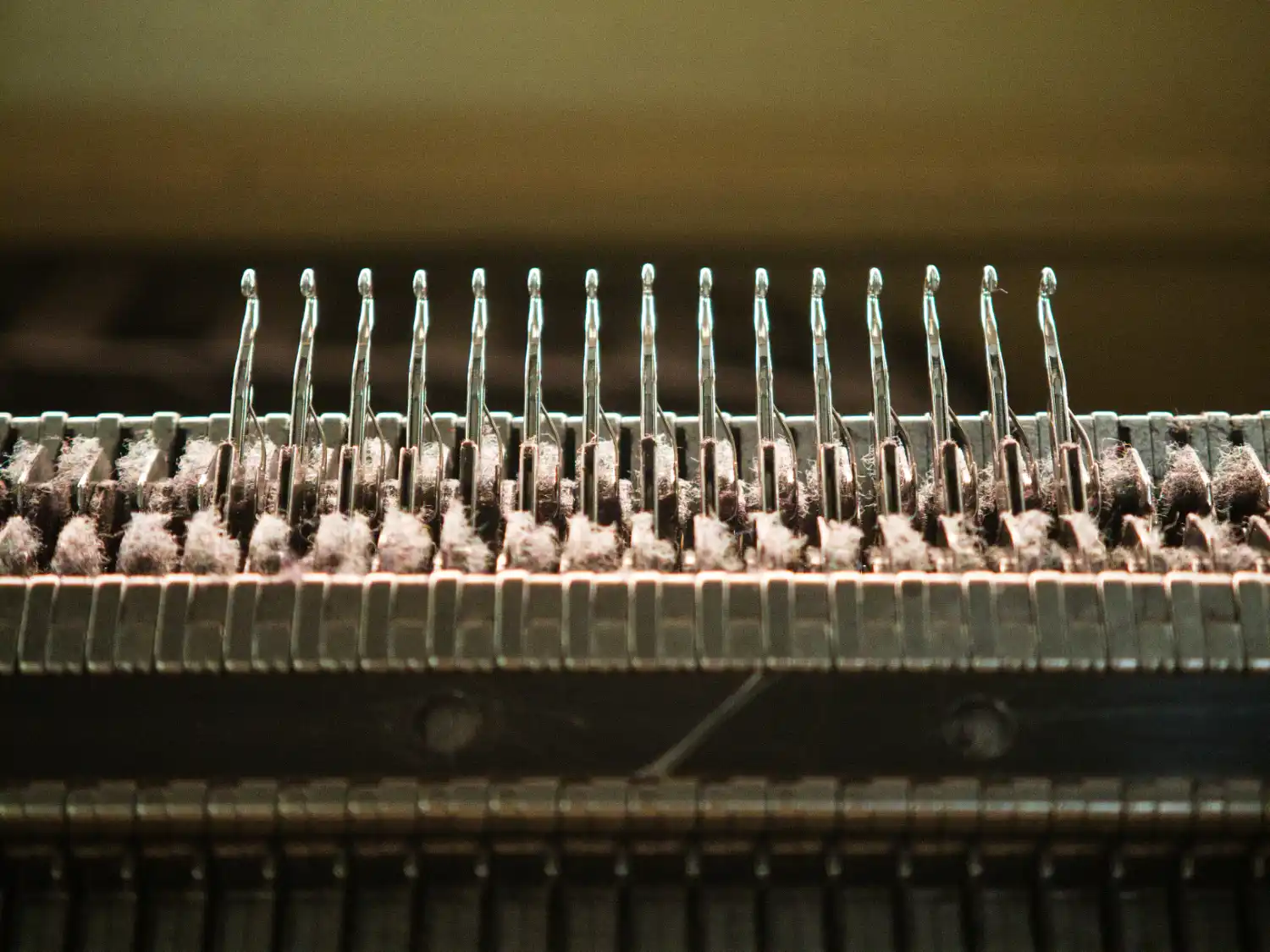
From a technical standpoint, gauge indicates the number of needles per linear inch on the knitting machine.
The closer the needles are, the finer, more compact, and more defined the knit structure becomes.
In practical terms:
- Low gauge → wider needle spacing → larger loops, bulkier fabrics, visible stitches
- High gauge → closer needles → finer, more compact fabrics with a cleaner surface
Observing the machine needle beds makes this concept immediately clear: the visible distance between the needles changes, explaining why the same stitch can produce garments with very different appearances.

Gauge Is Chosen Based on the Yarn
The choice of gauge does not start from aesthetics, but from the yarn.
Yarn is the first real technical constraint of a knitwear project and determines which gauges are compatible.
When evaluating a yarn, several factors come into play:
- Yarn count (actual thickness of the yarn)
- Fiber composition (wool, cotton, viscose, cashmere, blends, etc.)
- Yarn structure (combed, carded, chainette, bouclé, slub, etc.)
- Twist and overall stability
In general:
- Thicker yarn → lower gauge
- Thinner yarn → higher gauge
Yarn and gauge must therefore be selected together, as part of a single technical balance.
Forcing this relationship leads to concrete problems:
- A yarn that is too thick for a high gauge causes friction, yarn breaks, stiff stitches, and low productivity
- A yarn that is too thin for a low gauge results in an open, unstable, transparent fabric with a poor hand feel
During product development, choosing the gauge before selecting the yarn is one of the most common and most costly mistakes.

Hand Feel, Aesthetics, Weight, and Transparency
Beyond yarn selection, gauge has a direct impact on how a garment looks and how it is perceived when worn.
With the same stitch and yarn, changing the gauge can radically affect:
- Hand feel (compact, soft, dry, fluid)
- Actual and perceived weight
- Transparency or surface coverage
- Stitch definition and visual cleanliness
- Drape and the way the garment falls on the body
In general:
- Higher gauges tend to produce compact, uniform surfaces with a cleaner, more “tailored” appearance
- Lower gauges emphasize texture, volume, and three-dimensionality
It is important to note that gauge never works alone: machine tension and stitch structure play a fundamental role.
However, gauge defines the foundation on which everything else is built.
Gauge as an Industrial Choice
Gauge is not only an aesthetic or design decision it is also an industrial variable.
An inconsistent choice can:
- Slow down development timelines
- Increase sampling and programming time
- Make certain processes unreliable or difficult to industrialize
In production, this often results in:
- Longer machine running times
- Greater need for manual intervention
- Defects, reworks, and inefficiencies
Even a gauge that appears “correct” from an aesthetic perspective can become problematic if it has not been designed with the production process in mind.
The Real Cost of Gauge
When gauge is underestimated, the cost is not only technical—it is economic and strategic.
In practical terms, this can lead to:
- Higher costs due to additional tests, time, and corrective actions
- Longer timelines, with delayed development and production
- Reduced margins caused by rework, inefficiencies, and unexpected adjustments
- Wasted resources on projects that are later downsized or abandoned because they are too complex or unreliable
Gauge is therefore not a technical detail.
It is a decision that directly affects costs, timelines, and the final value of the garment.
Why Relying on an Experienced Partner Makes the Difference
Avoiding wasted time and budget does not mean simplifying projects or sacrificing quality.
It means making the right technical decisions from the very beginning, balancing aesthetics, performance, and industrial feasibility.
At Max Company, for over 60 years we have supported brands in the development of knitwear, from the earliest design stages through to final production.
Our role is not only to manufacture garments, but to translate creative ideas into reliable, coherent, and industrializable products.
Want to Learn More?
If you are developing a knitwear collection and want to avoid costly mistakes in terms of time and budget, working with an experienced technical partner is often the first step toward a stronger, more controlled project.
Discover how we can support you in developing your next knitwear collection.
